

The Deck 9 Bloodbath That Turned a Holiday Into a Floating Crime Scene

MS Viking Sally, pictured in Stockholm harbour in the 1980s
May 5 2026, Published 9:16 p.m. ET


Traveling by sea can be an amazing adventure. It is a unique experience that combines feelings of peace with excitement as you navigate vast, open waters. The allure of exploring new places, feeling the salty breeze on your face, and meeting a diverse group of people on board creates an atmosphere full of anticipation and camaraderie. However, there is a disturbing truth beneath this calm: you are trapped, with nowhere to run.
The idea of being confined on a ship with a psychopath has fascinated many, becoming a common trope in thriller and horror films. However, events aboard the MS Viking Sally in 1987 demonstrate that there is truth behind this fiction.
Some may say the ship was cursed—the scene of two murders, a maiming, and finally one of the greatest tragedies of the 20th century. However, this explanation shifts responsibility for the horrifying events into the realm of the supernatural, when the truth is that the terror aboard the Viking Sally was solely the result of human evil. It is a tale that will forever make you question the true nature of those with whom you share your travels.
The Trip of a Lifetime

German couple Klaus Schelkle and Bettina Taxis photographed in Stockholm before boarding Viking Sally
Twenty-year-old Klaus Schelkle and his twenty-two-year-old girlfriend, Bettina Taxis, likely expected memories that would last a lifetime. The West German couple had decided to tour the Nordic countries alongside their fellow student and friend, Thomas Schmid. Away from home, they could take in Scandinavia’s beauty before traveling to Lapland in Finland, one of the world’s most stunning natural regions. Klaus and Bettina had been together for six months, and with time alone and romance in the air, they anticipated an unforgettable experience. Klaus and Thomas, meanwhile, had been close friends for five years, bonded by a shared love of cars.
The trio planned to travel from West Germany to Sweden by rail, heading to the capital, Stockholm. From there, they would continue on to Turku, Finland, and then to Lapland before returning along the Norwegian coastline. Departing Stuttgart on July 23, 1987, they traveled through Denmark and eventually arrived in Sweden. They spent several days in Stockholm, sending postcards and letters home to reassure family and friends that they were enjoying their trip. However, the true heart of their journey began on July 27, when, at 10:00 p.m., they boarded the MS Viking Sally, part of the Viking Line fleet that sailed between Sweden, Finland, and Åland. The trio intended to cross the Gulf of Bothnia and dock in Turku at 8:00 a.m. the following morning.
The Viking Sally was a large but troubled ship. With a capacity of 2,000 passengers and 400 vehicles, she was launched in 1980 and served the Turku–Mariehamn–Stockholm route. The vessel had run aground in 1984, and in 1986 a passenger was murdered aboard her, with the perpetrator later described as one of the most dangerous criminals in Finland.
On July 10, 1986, Reijo Hammar entered businessman Antti Eljaala’s cabin and stole money from his wallet. When Eljaala attempted to raise the alarm, he was stabbed five times in the throat and strangled with the help of an accomplice. Hammar was arrested and convicted of the killing and was serving his sentence when Schelkle, Taxis, and Schmid boarded the Viking Sally, meaning he plays no role in this narrative. Nevertheless, the murder would be just one of several tragedies associated with the vessel, ultimately culminating in one of the greatest maritime disasters of the 20th century.
It is unlikely that the trio had even heard of Antti Eljaala’s murder, and even if they had, they would have had little choice but to continue aboard the Viking Sally. Once on board, everything appeared to be exactly as Klaus, Bettina, and Thomas had expected. They made a few small purchases in the ship’s shop and wandered the decks to familiarize themselves with the layout, likely searching for a place to bed down later.
Despite saving for the trip all year, the students were still short on cash and were forced to sleep in a public area rather than book private cabins. Still, they were determined to make the most of the journey and quickly became acquainted with their diverse fellow travelers. The atmosphere was social and convivial, with everyone being outgoing except for Schmid.
Among the passengers they met was a British man later identified in the press under the alias Patrick Haley. Haley was twenty-six years old and, unbeknownst to those aboard the Viking Sally, deeply troubled. His academic pursuits had failed, and a painful breakup with his former fiancée had sent him spiraling into drug use. Seeking a fresh start, Haley abandoned London to work on a kibbutz in Israel, a communal farming settlement popular with international visitors searching for direction. There, he met a Finnish student named Maija, and the two decided to travel to her home in Lapland. With little money, they moved through various countries, backpacking, taking odd jobs, and eventually finding themselves in Stockholm, preparing for the final leg of their journey into Finland.
However, just as the end seemed in sight, Haley was denied entry upon arriving in Helsinki and was sent back to Sweden. Penniless and disheveled, he had apparently been deemed undesirable by authorities. Stranded in Sweden and unwilling to be separated, Maija sent him just enough money to attempt reentry into Finland—this time via Turku. With that plan in mind, Haley boarded the Viking Sally.
Alongside Haley, the German travelers met Tauno, a Finnish businessman who delivered car parts. Tauno quickly bonded with Klaus, who was studying automotive technology. The two exchanged addresses, and Bettina affectionately nicknamed him the “Fun Finn.” Near the helicopter pad, the trio also met Sami, Pentti, and Ville from Finland, who had enjoyed a boys’ day out in Stockholm. Having spent nearly all their money on alcohol, they had only a few bottles left. The ship carried passengers from at least nine different countries, ranging from war veterans to a group of scouts, filling its decks and cabins with life and movement.
Horror at Sea

MS Viking Sally, pictured in Stockholm harbour in the 1980s
It was around 1:00 a.m. on Tuesday, July 28, and most passengers were either already asleep or preparing to turn in. Thomas was asleep, while Klaus and Bettina returned to collect their sleeping bags. Thomas had remained indoors to avoid the cold, and it also appears likely that the couple wanted some privacy for their sleeping arrangements, so they headed to Deck 9 at the stern of the vessel. The deck was open to the air, but they had found a secluded spot near the helipad that was dimly lit and partially sheltered by a plexiglass windscreen.
Elsewhere on the ship, Patrick Haley had joined Sami, Pentti, Ville, and several others. With the extra money Maija had sent him, he treated the group to food and beer. Passengers who were still awake later recalled that the group was loud and boisterous before eventually dispersing and settling down to sleep in different areas of the ship.
What occurred over the next several hours remains unclear. Shortly before 3:45 a.m., one of the scouts, eighteen-year-old Thomas Nielsen, woke early in his cabin and decided to go for a walk on deck. Nielsen had already been outside a few hours earlier and had seen Klaus and Bettina, with everything appearing normal at that time. He followed the same route again, and as he approached Deck 9, he discovered Klaus and Bettina surrounded by three other scouts from a separate Swedish group. All of the scouts were traveling to Finland for an upcoming jamboree. At first, Nielsen assumed the couple were intoxicated and struggling to stand, but it quickly became evident that both had sustained severe head injuries, with blood covering the deck.
“I was walking on the helicopter deck and suddenly saw three other boys by the sleeping bags. At the same time, I noticed that something was crooked. When I got closer, I noticed that there was blood everywhere, and the young people lying in the sleeping bags were covered in blood,” Nielsen would later say in an interview. “The boy tried to get up, by then he was outside the sleeping bag, but he couldn’t get up. The girl was inside the sleeping bag and tried to say something. Next to them were empty and full beer bottles.”
Shocked, Nielsen attempted to administer first aid while the other scouts ran to raise the alarm. However, it was immediately clear that the injuries were far beyond the scouts’ basic medical training. Within ten minutes, the ship’s captain, a nurse, and security personnel arrived on Deck 9. The couple had been the victims of a brutal attack, suffering severe blows to the head from an unknown weapon. Both required urgent medical attention.
“The face had not been hit or kicked, and in my opinion, the abuser had not used a knife either,” Nielsen revealed. “Their faces were like slush as if they had been beaten with something like a hammer. No wounds were visible on their bodies.”
Both Klaus and Bettina were moved indoors. Bettina appeared to be in far worse condition than her boyfriend and had to be carried from the scene by Nielsen, while Klaus was able to walk with assistance from the nurse. The Finnish Coast Guard urgently dispatched a helicopter, and both victims were airlifted to Turku University Hospital, arriving at 5:48 a.m. Tragically, it was already too late for Klaus Schelkle. Despite initially appearing less severely injured than Bettina, he died during the flight and was pronounced dead on arrival.
A Ship Full of Suspects
Given the Viking Sally’s route and the timing of the attack, the crime may have occurred either in Åland or Finnish waters. Åland is a sparsely populated, autonomous archipelago off the southern coast of Finland. Due to the severity of the crime, Finnish authorities determined that Åland lacked the necessary resources to conduct a full investigation and quickly ruled that the murder and attempted murder had taken place in Finnish waters, placing the case under the jurisdiction of the Turku police and the National Bureau of Investigation (NBI).
Finnish police acted swiftly. Detectives and crime scene investigators, led by Chief Constable Veikko Laaksonen, were dispatched immediately and arrived aboard the Viking Sally via the same helicopter that had transported Klaus and Bettina to the hospital. It was 6:30 a.m., and the ship was still at sea, less than two hours from docking in Turku. Officers made effective use of this time, aided by the foresight of security officer Raimo Vahlsten, who had ensured that the crime scene remained secured and untouched. Investigators collected fibers, fingerprints, shoe prints, and a bloody palm print from the scene. However, there were no immediate clues pointing to a perpetrator.
Police planned to surround the vessel upon arrival in Turku, lock down all passengers, and patrol the surrounding waters to prevent anyone from disposing of evidence overboard. However, these plans quickly unraveled. With approximately 1,400 passengers and limited facilities to detain them all, the operation became a logistical nightmare. As a result, police were forced to narrow their focus, allowing elderly passengers, families, and children to disembark.
Despite the broad scope of the initial investigation, police soon concluded that Klaus and Bettina had likely known their attacker. They immediately detained Thomas Schmid, Patrick Haley, and the group of intoxicated youths. Haley drew particular attention after he was found wearing bloodstained clothing that morning. He claimed the blood was his own, the result of a nosebleed. Investigators found the explanation convenient and subjected him to repeated interviews while awaiting forensic analysis. Testing ultimately indicated that the blood was almost certainly his own, though the results were not entirely conclusive and did not fully rule out the possibility that he had been injured during a struggle.
Schmid, meanwhile, was released once it became clear that he had no involvement in the attack. He knew nothing of the events beyond being awakened when Klaus and Bettina retrieved their sleeping bags.
“When the police came to wake me up, I had no idea what had happened,” Schmid would later say. “We were sitting up on the deck, but the air was cold, and I went inside to look for a place to sleep… After half an hour, I woke up to Klaus and Bettina coming to get their sleeping bags. They were in a great mood and said they had met a nice Finn. Then they faded away. It was around midnight then.”
The Evidence That Wouldn’t Talk
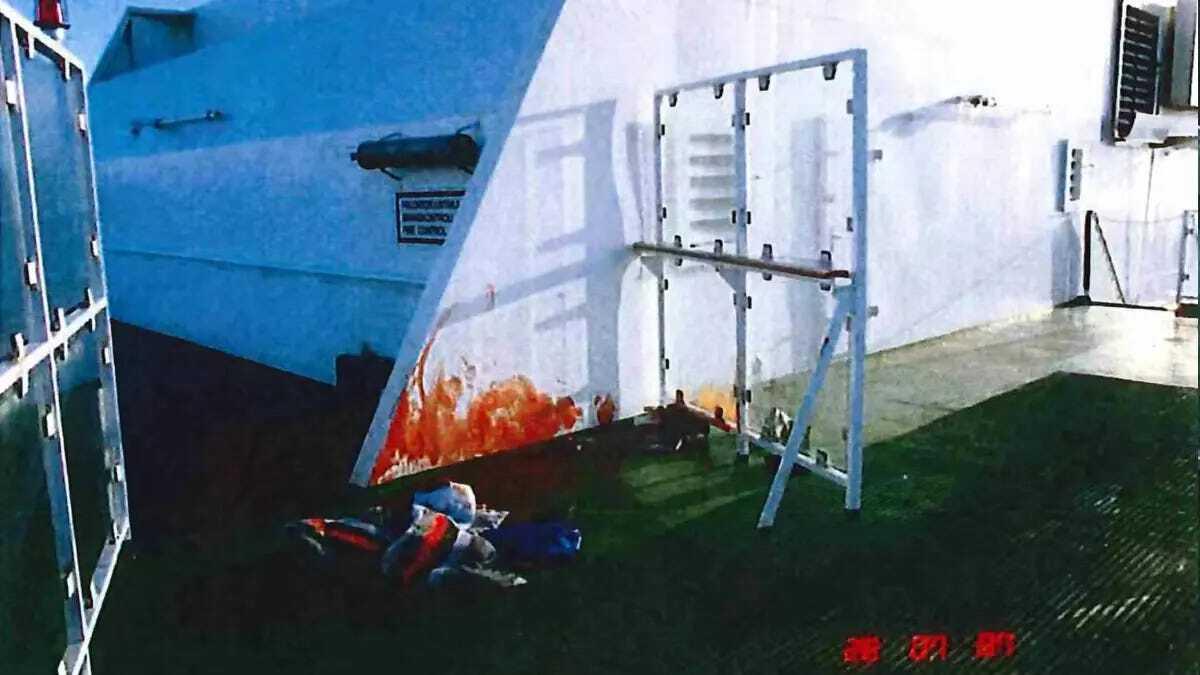
Turku Police photos of the crime scene
Unfortunately for investigators, the circumstances of the killing significantly hampered the investigation. Managing a crime involving 1,400 passengers aboard a vessel that needed to disembark, alongside a busy dock serving travelers bound for multiple countries, was challenging enough. Compounding these difficulties, the crime scene near the helipad was isolated, lacked CCTV coverage, and police were unable to conduct a full forensic search of the ship. The evidence that was collected yielded little insight. Fibers recovered from the scene revealed nothing of value, and blood tests showed no anomalies, indicating that only Klaus and Bettina had bled. There were no unusual shoe prints, and the bloody palm print found on a wall could not be matched to anyone who was tested.
Meanwhile, Bettina Taxis made a strong physical recovery from the attack. However, she is believed to have been left with serious, lifelong injuries, including the amputation of a finger, likely sustained while attempting to defend herself. Police have never publicly released the full details of her statements, but it is known that she had no memory of events between entering the sleeping bag and waking up ten days later. The last thing she recalled was Klaus listening to music through earphones for a short while before removing his glasses and placing them inside his shoe for safekeeping. The couple then went to sleep. Investigators continued their efforts, tracing and interviewing as many passengers as possible and traveling aboard the ship multiple times in search of new clues, but with little success.
In August, a fisherman discovered a bag of clothing on the tiny, uninhabited island of Lilla Björnholm, located just 200 meters from the shipping lane. The fisherman left the bag untouched for an entire year, only realizing in 1988 that it was still there. Inside were several items, including a glove bearing the initials “HK,” a pair of shoes, and a sweater. Police believed forensic evidence linked the bag to the Viking Sally, though none of the items reportedly showed traces of blood.
Whether an earlier discovery of the bag might have aided the investigation remains unknown. Fresher memories may have helped identify the owner, but by this point, the case had completely stalled.
In total, police interviewed more than 1,000 people and sent over 250 samples to NBI laboratories for analysis. Thousands of pages of documentation were generated, and investigators worked across nine countries to trace those who had been aboard the Viking Sally. The sheer volume of information proved overwhelming.
From Horror to Tragedy
In late 1987, the MS Viking Sally was sold to Silja Line and placed on a new route. In 1990, she was completely repainted and renamed Silja Star, returning to the Turku–Mariehamn–Stockholm route. The following spring, the vessel was transferred to Wasa Line and renamed once again, this time to Wasa King, before being sold in 1993 to Estline, a Swedish-Estonian shipping company. Upon her sale, the ship became the largest Estonian-owned vessel of the era, and many took pride in her as a symbol of the country’s newly regained independence from the Soviet Union. As such, there was only one fitting name for her: the MS Estonia.
On Wednesday, September 27, 1994, the former Viking Sally departed for Stockholm with 989 passengers on board, most of them Swedish. Poor cargo distribution caused the ship to list slightly to starboard, and weather conditions were rough. In the early hours of September 28, waves began striking the bow doors near the Turku archipelago—the same waters where Klaus Schelkle had been murdered years earlier. Metallic banging echoed throughout the ship as the bow door locks failed. The bow visor and door separated, tearing open the loading ramp to the sea. The vessel listed further to starboard, the vehicle deck flooded, and the ship began to sink shortly after 1:00 a.m.
The flooding was rapid and catastrophic. Water burst into the ship through the vehicle deck, trapping hundreds of passengers below. Many were unable to reach the upper decks and drowned in their cabins. Water surged through windows, ceiling panels, stairwells, and corridors. A mayday call was issued at 1:22 a.m., and by 1:50 a.m., Estonia had vanished from radar. The sinking took less than an hour. Of the 989 people on board, 852 perished, making the loss of the MS Estonia—formerly the Viking Sally—one of the worst peacetime maritime disasters in European history, surpassed only by the Titanic and the Empress of Ireland.
A New Suspect
With the ship gone and the investigation into Klaus Schelkle’s murder closed in the 1990s, it appeared the Viking Sallykilling would remain a permanent cold case. Police had no clear forensic evidence, no witnesses, and no established motive—making the murder seem almost like a perfect crime. However, in 2019, Finnish police revealed that they had identified a new prime suspect. They disclosed only that the suspect was male, still alive, and believed to have acted alone. At the same time, they appeared to exonerate longtime suspects such as Patrick Haley by stating they no longer believed the killer had known Klaus or Bettina prior to the attack.
So confident were Turku police in their findings that in September 2020 they declared the case solved and forwarded their material to prosecutors. Two months later, in December, prosecutors indicted a 51-year-old Danish man, Herman Himle, on a charge of murder. In 1987, Himle had been known by his birth name—Thomas Nielsen—the 18-year-old Boy Scout who had discovered Klaus and Bettina after the attack.
Himle had been questioned during the original investigation. His scout leader reported that he “enjoyed being in the spotlight and didn’t seem sad or troubled at all by what he must have experienced on the ship.” The leader also recalled seeing Himle covered in blood but assumed it came from assisting the victims and even helped him find clean clothes while washing the bloody ones.
After the 1987 attack, Himle gave a detailed interview to Seura magazine—quoted earlier in this account—in which he described the events of that morning in striking detail. He even stated that the murder weapon had been a hammer rather than a knife, a conclusion that would have been difficult for someone merely discovering the victims on a darkened deck. In the years that followed, Himle drifted in and out of prison, serving sentences for robbery, theft, weapons offenses, and threats of violence. During this time, he repeatedly invoked the killing of Klaus Schelkle for his own purposes—bragging about having gotten away with murder or using it to intimidate others. He even confessed to the leader of a prison choir, who later told the press that the murder was a “great sadness” for Himle and that she believed him to be a “true psychopath.”
In 2015, Himle sent multiple threatening text messages to his ex-wife, admitting to the attack. Among the statements attributed to him were: “I am a murderer, and I can prove it, but then I would go to prison for a long time,” and, “You’re right that I’m evil; I’ve killed two people.”
“I’ve been interrogated, and they can’t do anything about that ship thing,” one of the messages from Himle read. “I remember the ship like it was yesterday. Yes, I am a murderer, and I can prove it, but then I will go to jail for a long time, and I will not go to jail because then you will escape my revenge which will come when you least expect it.”
With police now involved, Himle reportedly confessed “off the record” in 2016 while incarcerated in Denmark. Finnish officers Mika Paaer and Sirpa Saarinen visited him in prison, where he indicated that he was responsible for the killing. Paaer quickly gained his trust. During a second visit the following day, Himle explained how he “could have done it” and declined legal representation. After the formal interview ended, Himle suggested they continue the discussion in the prison yard, where he provided further details and confessed directly to Paaer—who did not record the conversation.
Himle disclosed that the weapon used was a slag hammer, a heavy welding tool with both a blunt end and a sharp edge. Forensic analysis suggested such a weapon could have caused the injuries suffered by the victims, and Himle demonstrated knowledge of details that had never been made public. He claimed to have thrown the weapon overboard just before the Swedish scouts arrived, stating that he had been hiding nearby the entire time.
When discussing motive, Himle was vague. He suggested robbery had been the underlying reason and claimed his mental state was impaired by personal issues at home in Denmark before the trip. He described feeling cornered, angry over a lack of financial support and equipment, and said he lashed out while simultaneously attempting to steal from the couple. Afterward, he inserted himself into the rescue and investigation, embracing the role of a hero—a behavior seen in other offenders.
“Himle said that he would like to tell [Bettina Taxis] that she no longer has to be afraid. He said that the woman can be told that the police talked to the right man today,” police later said. “He said that he dared to say this because the police would never be able to prove him as the perpetrator. He didn’t want to directly admit that he killed Klaus Schelkle and that he he tried to kill Bettina Taxis because he considered that his statement now was enough to tell who the perpetrator was.”
In 2019, dissatisfied with the quality of earlier interviews, Finnish prosecutors sought to question Himle again. This time, he denied everything. Nevertheless, prosecutors moved forward.
What “Obvious” Can’t Prove
Herman Himle was brought to trial in May 2021, and the prosecution’s case quickly unraveled. His confessions were ruled inadmissible, having been made without legal counsel, without independent witnesses, and during interviews conducted in English, which was not his native language. The questioning was found to be leading, and documentation was incomplete. His ex-wife refused to testify for mental health reasons, though earlier police statements indicated she lived in fear of him. Other key witnesses, including the scout leader, had died in the decades since the attack.
“It is such a bad violation of rights that we cannot accept that such a thing is used here,” lawyer Martina Kronström told Aamulehti. “He didn’t have an assistant, he was in such a state that it would have been impossible to have a conversation without an assistant, and besides that, he has been consulted in a language he doesn’t know.”
The defense argued that Himle was a fantasist who used the murder to enhance his reputation within criminal circles or to intimidate others. The court ruled that prosecutors had failed to establish a motive or prove that Himle was the only person with the opportunity to commit the crime. He was acquitted in June 2021. Any notion that he had abandoned his criminal life proved false when he was arrested again for arson in March 2023.
While Himle may appear to be the strongest candidate for solving the case, justice requires proof beyond a reasonable doubt. His being covered in blood could plausibly be explained by assisting the victims. His confessions may point toward guilt, but history is filled with false confessors. Even the identity of the murder weapon remains uncertain.
Motive remains equally elusive. Police never believed robbery was the cause, as no property was missing. Klaus and Bettina had left most belongings with Schmid, and police photographed those items—nothing was taken. Himle himself gave conflicting explanations, at times claiming the couple had merely annoyed him.
The defense also argued that other scouts would have noticed blood on Himle, while prosecutors countered that lighting was poor and his clothing was dark. Other potential suspects were raised, including a fabric worker who died by suicide in 1988 and the unknown owner of clothing found on Lilla Björnholm.
Despite a long criminal record, Himle had never been convicted of a violent offense before or after the Viking Sally attack. The brutality of the assault—standing over two sleeping victims and repeatedly striking their heads—raises further questions. Would such a ferocious act truly be a first and only violent crime?
What is certain is that the attack on Klaus Schelkle and Bettina Taxis was savage, merciless, and profoundly disturbing. A journey meant to be filled with youth, romance, and adventure ended in unimaginable violence. Whether Herman Himle was responsible remains unproven. The failures of the prosecution and the absence of conclusive evidence led to his acquittal.
The case illustrates how difficult justice can be to achieve. What may appear obvious is not always provable, and history offers many examples of wrongful convictions based on assumption rather than evidence. The justice system exists to guard against that outcome, even when doing so is deeply unsatisfying.
In the end, the chance for definitive justice slipped away just as it seemed the final ghost of the Viking Sally might be laid to rest. And while nothing can be said beyond reasonable doubt, perhaps Himle’s own words offer the most haunting insight. Speaking to police, he once remarked that “every human being has a demon or a devil that needs to be let out.”
It seems likely that such a demon walked Deck 9 of the Viking Sally on a tragic summer morning in 1987.
Become a Front Page Detective
Sign up to receive breaking
Front Page Detectives
news and exclusive investigations.